
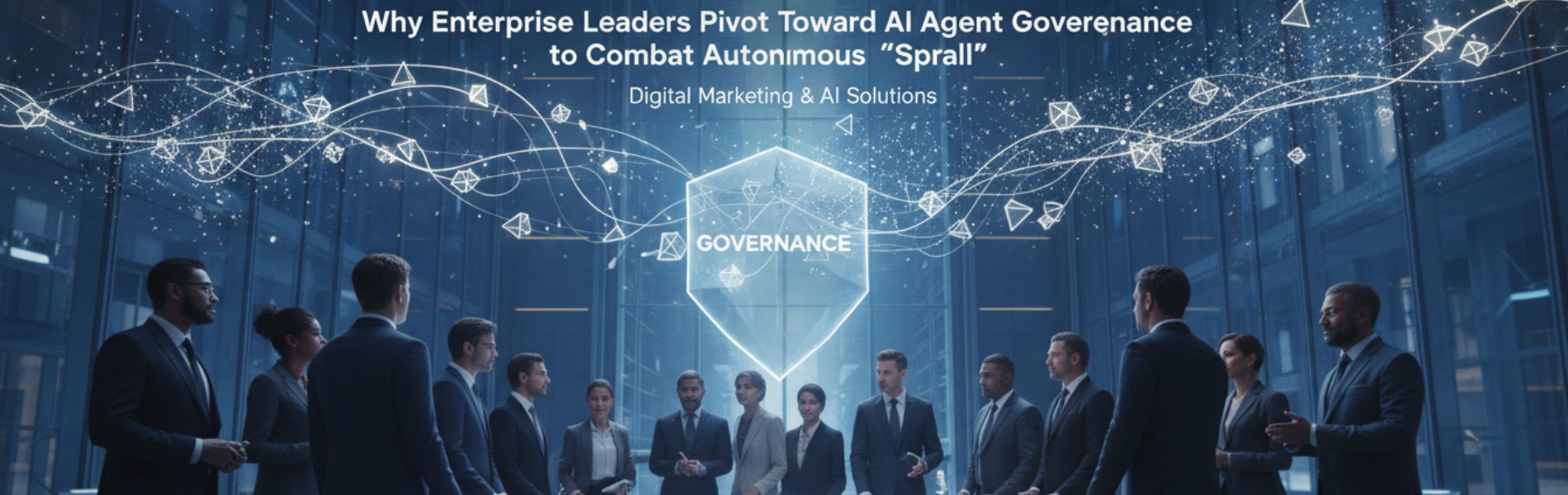
Taming the Swarm: Why Enterprise Leaders Pivot Toward AI Agent Governance to Combat Autonomous 'Sprawl'
In the rapidly evolving landscape of Generative AI, a new paradigm is shifting the operational foundations of the enterprise. We have moved beyond simple chatbots and static prompts into the era of Autonomous AI Agents. These intelligent entities are capable of planning, executing complex workflows, and interacting with other systems with minimal human oversight. However, this technological leap brings a critical challenge that C-Suite executives can no longer ignore: Autonomous Sprawl.
Much like the 'Shadow IT' of the cloud era, where unauthorized applications multiplied unchecked, AI Agent Sprawl represents the proliferation of unmanaged, unmonitored, and potentially insecure autonomous agents within corporate networks. As a result, forward-thinking Enterprise Leaders are urgently pivoting toward robust AI Agent Governance frameworks. At IITWares, we recognize that while agents unlock unprecedented productivity, they require a sophisticated control plane to ensure Data Privacy, security, and strategic alignment.
The Emergence of Autonomous Sprawl
The democratization of Large Language Models (LLMs) and agentic frameworks (like AutoGPT, LangChain, and proprietary enterprise tools) has made it incredibly easy for departments to deploy specific agents for specific tasks. Marketing might deploy an agent for social listening; HR might deploy one for candidate screening; Engineering might use coding assistants.
Autonomous Sprawl occurs when these agents operate in silos, without a centralized registry or standardized protocols. The risks are manifold:
- Redundant Operations: Multiple agents performing identical tasks across different business units, driving up Compute Costs.
- Hallucination Loops: Agents interacting with other agents, compounding errors or 'hallucinations' without human correction.
- Security Vulnerabilities: Unmonitored agents possessing excessive privileges, creating new attack vectors for Cybersecurity Threats.
Comparing Shadow IT to Shadow AI
While Shadow IT involved unauthorized software installation, Shadow AI involves unauthorized action. An ungoverned agent doesn't just sit on a server; it executes transactions, sends emails, and queries databases. IITWares advises that the kinetic nature of agents makes Governance not just a compliance checkbox, but an operational necessity.
The Strategic Pivot: From Experimentation to Control
The initial phase of the AI revolution was defined by experimentation. Enterprises encouraged teams to 'move fast and break things' to understand the capabilities of Generative AI. Now, as the technology matures, the pendulum is swinging toward stability and control. Leaders are realizing that scalable adoption requires a pivot toward AI Governance.
This pivot is driven by the realization that an organization cannot scale what it cannot see. Enterprise Leaders are now demanding 'Observability'—the ability to track the reasoning, actions, and resource consumption of every agent in the ecosystem. This is where IITWares steps in, helping organizations transition from chaotic swarms of bots to orchestrated, disciplined digital workforces.
Key Pillars of AI Agent Governance
To combat sprawl, organizations must implement a multi-layered governance strategy. This involves more than just policy documents; it requires technical guardrails and architectural changes.
1. Identity and Access Management (IAM) for Agents
In a governed environment, every AI Agent must have a unique identity, similar to a human employee. This concept, known as 'Machine Identity Management', ensures that agents are authenticated and authorized before they can access sensitive data. Zero Trust Architecture principles must be applied to agents. An agent designed to summarize emails should not have permission to delete entries in the CRM Database.
2. The 'Human-in-the-Loop' Protocol
Autonomous does not mean unsupervised. Effective governance mandates Human-in-the-Loop (HITL) checkpoints, especially for high-stakes decisions. IITWares recommends configuring agents with confidence thresholds; if an agent's confidence in a decision falls below a certain percentage, it must escalate the issue to a human operator. This prevents runaway errors and mitigates the risk of Reputational Damage caused by erratic bot behavior.
3. Centralized Orchestration Planes
To stop sprawl, enterprises need a centralized view—a 'Control Tower' for AI. This orchestration layer tracks which agents are active, what versions of LLMs they are using, and what APIs they are consuming. This centralization allows IT leaders to decommission zombie agents (agents that are running but no longer adding value) and enforce global updates to Compliance Policies.
The Risks of Inaction: Data Leakage and Compliance
The most terrifying aspect of Autonomous Sprawl is the potential for Data Leakage. An improperly governed agent might inadvertently ingest Personally Identifiable Information (PII) and use it to retrain a public model, or share proprietary trade secrets with external APIs. With regulations like GDPR, CCPA, and the emerging EU AI Act, the legal ramifications of such leakage are severe.
IITWares emphasizes that governance is the only shield against these regulatory penalties. By enforcing strict data sanitization protocols and egress filtering within the agent architecture, enterprises can innovate without exposing themselves to legal liability.
How IITWares Facilitates Secure AI Adoption
At IITWares, we understand that governance should not be a bottleneck to innovation. Instead, it should be the safety harness that allows you to climb higher. We assist Enterprise Leaders in designing and deploying custom governance frameworks tailored to their specific industry needs.
Our approach involves:
- Agent Auditing: conducting comprehensive audits to identify all active agents within the enterprise network.
- Guardrail Implementation: deploying technical constraints using Open Source and proprietary tools to limit agent behavior.
- Lifecycle Management: establishing clear protocols for the creation, deployment, updating, and retirement of AI agents.
We believe that the future of enterprise software belongs to those who can harness the power of Autonomous Agents without losing their grip on the steering wheel. By partnering with IITWares, organizations can ensure that their digital workforce remains an asset, not a liability.
Conclusion: The Era of Orchestrated Autonomy
The pivot toward AI Agent Governance marks the maturation of the AI industry. We are leaving the 'Wild West' phase and entering the era of 'Orchestrated Autonomy'. Autonomous Sprawl is a formidable challenge, but it is also a signal of massive potential scale. By implementing strong governance, Identity Management, and centralized orchestration, Enterprise Leaders can combat sprawl and harness the true transformative power of AI.
As IITWares continues to lead in delivering cutting-edge software solutions, our message is clear: Don't just build agents; govern them. Secure your infrastructure, protect your data, and prepare your enterprise for a future where humans and machines collaborate securely and efficiently.