
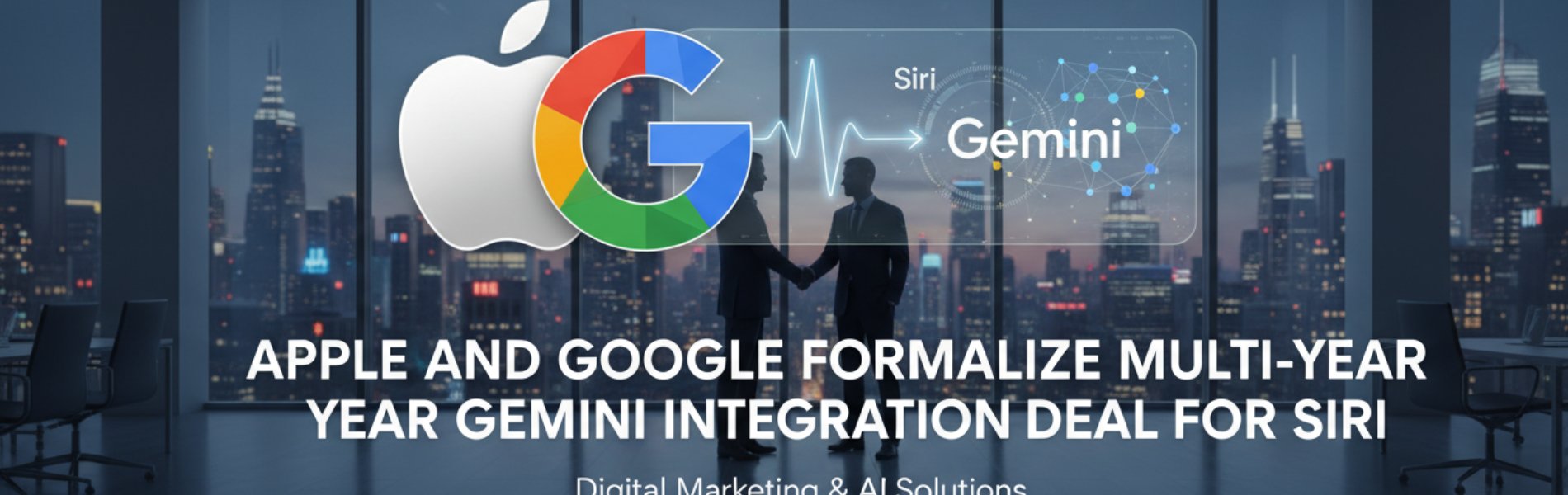
Apple and Google Formalize Multi-Year Gemini Integration Deal for Siri: A Paradigm Shift in Mobile AI
In a move that fundamentally alters the trajectory of the consumer technology landscape, Apple and Google have officially formalized a multi-year partnership to integrate Google Gemini—Google's most advanced Generative AI model family—directly into the iOS ecosystem. This historic collaboration marks a pivot from strict competition to strategic cooperation, aiming to overhaul the capabilities of Siri and bolster the newly announced Apple Intelligence framework.
For industry observers and developers at IITWares, this deal represents more than just a feature update; it is a consolidation of power between two tech giants designed to accelerate the mass adoption of Large Language Models (LLMs) across billions of devices. Below, we analyze the technical mechanics, strategic implications, and the future of this heavy-weight alliance.
The Mechanics of the Deal: Gemini Meets Siri
The core of this agreement revolves around augmenting Siri with off-device, high-performance cloud intelligence. While Apple has made significant strides with its proprietary on-device models for improved latency and privacy, the company recognizes the need for a more robust engine to handle complex, open-ended queries.
Under the new integration, when a user poses a request that exceeds the capabilities of the on-device neural engine, Siri can seamlessly offload the query to Google Gemini. This handover is designed to be frictionless, though Apple has emphasized user agency; iOS 18 users will likely see a prompt asking for permission to share specific data with Google for that interaction.
Key Integration Points
- Contextual Understanding: Gemini brings world-class reasoning capabilities, allowing Siri to understand nuance, follow-up questions, and multimodal inputs (text, voice, and image).
- Writing Tools: System-wide writing tools in iOS, iPadOS, and macOS will leverage Gemini for rewriting, summarizing, and proofreading text across third-party apps.
- Image Generation: The deal reportedly includes access to Gemini's image generation capabilities, allowing users to create visuals directly within Apple's ecosystem apps like Messages and Keynote.
Strategic Implications: Why Google?
The choice of Google as a primary partner—alongside the previously announced OpenAI ChatGPT integration—signals Apple's "model-agnostic" strategy. However, the Google Gemini deal carries distinct weight due to Google's search infrastructure and existing relationship with Apple regarding the default search engine on Safari.
For Google, this is a defensive and offensive masterstroke. It ensures that Gemini remains the dominant AI utility for the massive iPhone install base, preventing competitors from monopolizing the mobile AI interface. For Apple, it offloads the immense capital expenditure (CapEx) required to train and maintain a frontier-level Foundation Model, allowing Cupertino to focus on hardware integration, user experience, and the Private Cloud Compute architecture.
Privacy and Data Security Architecture
At IITWares, we understand that data privacy is the paramount concern for enterprise and consumer clients alike. Apple has been rigorous in distinguishing between on-device processing and cloud-based AI.
Apple maintains that requests routed to Google Gemini will adhere to strict privacy protocols. Unlike standard Google interactions, queries sent through Siri are reportedly stripped of IP addresses, and Google is contractually prohibited from storing the data to train future models. This creates a "privacy wrapper" around Gemini when accessed through Apple devices, aiming to resolve the tension between data security and the utility of cloud computing.
Impact on the Developer Ecosystem
This integration fundamentally changes how developers should approach App Intents and SiriKit. With Siri gaining the ability to reason and interact with on-screen content via Apple Intelligence, apps that expose clear intents will benefit from increased discovery and usage.
Opportunities for Innovation
Developers generally do not need to rewrite their apps to benefit from Gemini integration, provided they adhere to standard Apple APIs. However, the increased intelligence of the OS means that users will expect apps to handle complex, natural language instructions. IITWares advises clients to:
- Optimize for App Intents: Ensure your application's core functions are exposed to the system, allowing Siri (powered by Gemini) to trigger specific actions deep within the app.
- Refine Data Structures: Clean, structured data within applications will be easier for the AI to parse, summarize, and retrieve.
- Prepare for Multimodal Input: As users get accustomed to sending images to Siri for analysis (e.g., "What represents this chart?"), apps should be ready to handle high-fidelity outputs generated by the AI.
The Competitive Landscape: Apple vs. The Rest
This deal places significant pressure on competitors like Samsung and Microsoft. While Samsung has already integrated Gemini into its Galaxy S24 series, Apple's implementation promises a deeper level of OS-level cohesion. Meanwhile, Microsoft, heavily invested in the OpenAI ecosystem, finds itself competing against a unified Apple-Google front in the mobile space.
Furthermore, this multi-year agreement suggests that Apple is not planning to replace third-party LLMs with its own model entirely in the near future. Instead, Apple is positioning itself as the ultimate aggregator of AI services—a gatekeeper that curates the best models for the user, whether that is Gemini, GPT-4o, or eventually, models from Anthropic or others.
Conclusion: A New Baseline for Mobile Computing
The formalization of the Apple and Google partnership regarding Gemini is a watershed moment. It bridges the gap between Apple's hardware excellence and Google's software intelligence. For the end-user, the promise is a Siri that finally works as advertised—a truly smart assistant capable of managing digital lives.
For businesses and developers, the message is clear: Generative AI is no longer a novelty; it is the operating system's new runtime. Adapting to this reality—where an AI intermediary often stands between the user and the application—is critical for future success. As iOS 18 rolls out, the synergy between Apple's ecosystem and Google's machine learning prowess will likely set the standard for the next decade of mobile computing.