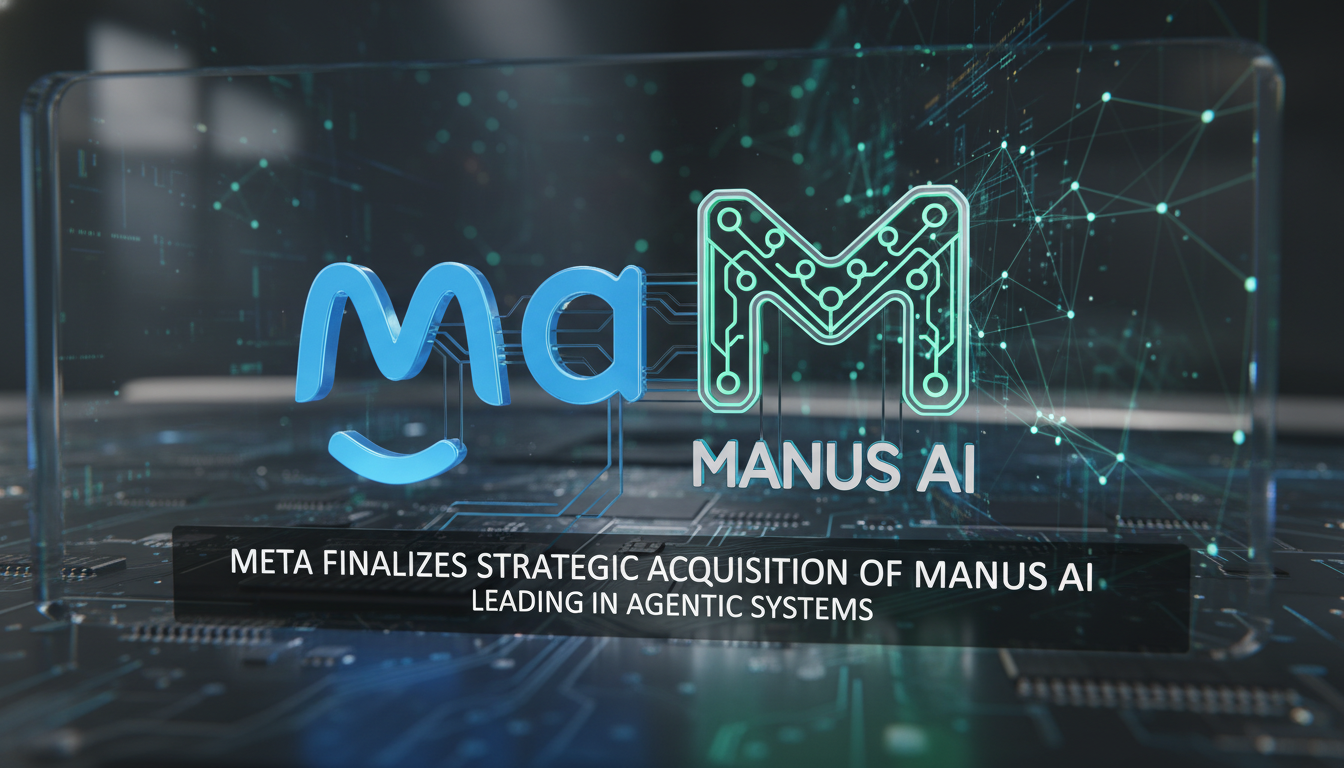

Meta Finalizes Strategic Acquisition of Manus AI to Lead in Agentic Systems
In a move that sends shockwaves through the Silicon Valley ecosystem and the broader artificial intelligence landscape, Meta Platforms, Inc. has officially finalized its strategic acquisition of Manus AI. This high-profile deal marks a pivotal moment in the race toward Artificial General Intelligence (AGI), signaling Meta’s aggressive transition from standard generative models to fully autonomous agentic systems.
For technology consultancies and developers like us at IITWares, this acquisition is more than just corporate consolidation; it represents a fundamental shift in how we will architect, deploy, and interact with software in the coming decade. By integrating the capabilities of Manus AI—a company renowned for its breakthroughs in generalist agents that convert natural language into complex digital actions—Meta is poised to redefine the utility of its open-source Llama models and its hardware ecosystem.
The Rise of Agentic AI: Beyond the Chatbot
To understand the magnitude of this acquisition, one must first understand the current bottleneck in the AI industry. For the past two years, the spotlight has been dominated by Large Language Models (LLMs) capable of generating text, code, and images. While impressive, these models are largely passive; they wait for a prompt and return information. They do not do things independently.
Manus AI has been a pioneer in solving this limitation. Their technology focuses on Large Action Models (LAMs) and agentic workflows. An agentic system is designed to perceive its environment, reason through a sequence of necessary steps, and execute actions to achieve a goal without constant human oversight. Unlike a chatbot that tells you how to book a flight, a Manus AI agent logs into the travel portal, selects the seat, processes the payment, and adds the itinerary to your calendar.
Why Manus AI?
Manus AI gained significant traction with its demonstration of a general-purpose agent capable of navigating any app or website just as a human would. By acquiring this technology, Meta secures a critical infrastructure layer that bridges the gap between the cognitive reasoning of Llama 3 and actual digital execution. This allows Meta to bypass the limitations of API-dependent integrations, enabling their AI to interact with legacy software and modern web interfaces alike.
Synergy with Meta’s Llama Ecosystem
Mark Zuckerberg has been vocal about his vision for open-source AI to democratize access to advanced intelligence. The integration of Manus AI into the Llama ecosystem suggests a future where developers can download not just a reasoning engine, but a fully capable digital worker.
For software engineers and AI architects, this opens up unprecedented possibilities. Imagine an open-source Llama-Manus hybrid model that can be fine-tuned for specific enterprise tasks—such as automated QA testing, complex data entry across disconnected systems, or autonomous customer support that resolves tickets rather than just answering them.
At IITWares, we anticipate this will accelerate the development of RPA (Robotic Process Automation) 2.0, where brittle scripts are replaced by resilient, adaptive AI agents capable of handling UI changes and unstructured data with ease.
The Hardware Play: Ray-Ban Meta and the Metaverse
While the software implications are vast, the acquisition of Manus AI creates a massive value proposition for Meta’s hardware division, specifically Reality Labs. Meta has seen surprising success with its Ray-Ban Meta smart glasses. However, the utility of these glasses has been limited to capturing media and voice interactions.
With agentic AI, smart glasses become a true proactive assistant. Because Manus AI specializes in visual understanding and interface navigation, it can serve as the "brain" that interprets what the user sees and acts on it. A user might look at a concert poster and say, "Book tickets for this." The Manus-powered assistant would visually scan the date and QR code, navigate the ticketing site in the background, and complete the purchase.
This closes the loop on the Metaverse and Augmented Reality (AR). The friction of inputting commands in a spatial environment is high; autonomous agents reduce that friction to zero. This aligns perfectly with Meta’s long-term strategy to make the smartphone secondary to wearable AI hardware.
Implications for the AI Industry and Competition
The acquisition places intense pressure on competitors like Google (DeepMind), OpenAI, and Microsoft. While OpenAI has demonstrated agentic capabilities with tools like the "Operator," Meta’s open-weight strategy combined with Manus AI’s proprietary action-oriented architecture creates a "moat" rooted in community adoption.
If Meta releases an open version of an agentic framework, it could become the standard operating system for AI agents, much like Android became the standard for mobile. This would force other players to accelerate their own agentic roadmaps, likely leading to a rapid explosion of tools available to firms like IITWares to build custom solutions for clients.
What This Means for Enterprise Integration
For the enterprise sector, the Meta-Manus deal signals that the era of "piloting AI" is ending and the era of "deploying AI workers" is beginning. Businesses will no longer look for AI that summarizes meetings; they will look for AI that organizes the meeting, sends the invites, prepares the agenda based on previous emails, and updates the CRM afterward.
However, this shift introduces new challenges regarding AI safety and governance. Autonomous agents that can execute financial transactions or modify databases present higher risks than passive LLMs. Meta will need to implement rigorous guardrails—an area where Manus AI has reportedly invested heavily ensuring their agents operate within strict user-defined permissions.
The Role of Consultancies like IITWares
As these agentic systems become commercially available, the complexity of implementation will rise. Integrating a decision-making agent into a legacy enterprise stack requires deep expertise in system architecture, security protocols, and AI orchestration. IITWares stands ready to help businesses navigate this transition, leveraging the new capabilities provided by the Meta-Manus union to build more efficient, automated, and intelligent workflows.
Conclusion: The Agentic Era Begins
Meta’s acquisition of Manus AI is a definitive declaration that the future of AI is agentic. By combining the reasoning power of world-class LLMs with the execution capabilities of Manus, Meta is building a future where technology acts as a partner, not just a tool.
For developers, business leaders, and tech enthusiasts, the message is clear: the focus has shifted from "What can AI say?" to "What can AI do?" As we watch this integration unfold, IITWares will continue to monitor, test, and deploy these cutting-edge technologies to deliver superior value to our partners.