
Discover why generic Arabic AI fails in Saudi Arabia and how dialect-native GenAI models like ALLaM and Kawn are revolutionizing business engagement for the 63% of Saudis under 30. A deep dive by IITWares.
For decades, the digital voice of business in the Arab world has sounded like a news anchor reading a legal disclaimer. It was formal, stiff, and utterly devoid of the warmth that defines Saudi hospitality. It was Modern Standard Arabic (MSA)—the *lingua franca* of academia and government, but certainly not the language of the Riyadh street, the Jeddah café, or the Abha majlis. When a customer in Al-Qassim sends a WhatsApp inquiry asking, “Wesh el-salfah?” (What’s the story/deal?), and receives a sterile, robotic reply in classical Arabic beginning with “Ahlan wa Sahlan,” the connection is instantly severed. The trust is gone. The brand feels foreign, detached, and increasingly obsolete.
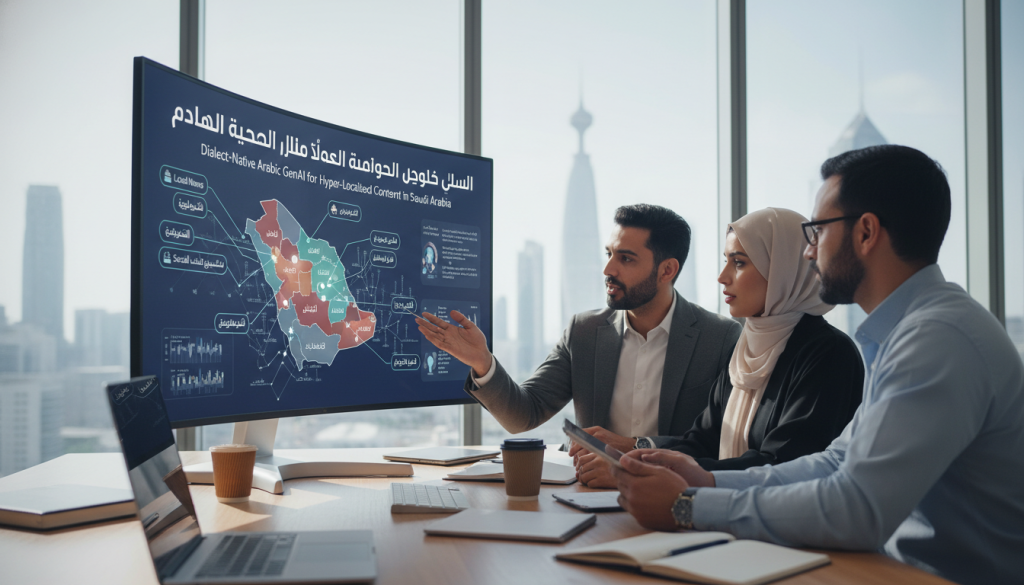
We are standing on the precipice of a linguistic revolution in Artificial Intelligence. The era of generic Arabic NLP (Natural Language Processing) is ending. In its place rises the age of Dialect-Native GenAI—hyper-localized models capable of understanding and generating the intricate nuances of Khaleeji vernaculars. With the launch of Saudi-specific Large Language Models (LLMs) like ALLaM and Kawn, the technological landscape has shifted dramatically. There is now an explosive demand for AI tools that do not just translate words but interpret culture. For IITWares and the forward-thinking enterprises we serve, this is no longer a ‘nice-to-have’ feature; it is the definitive competitive edge in a market where 63% of the population is under 30 and prioritizes cultural authenticity above all else.
1. The Modern Standard Arabic Disconnect: Why “Generic” No Longer Converts
To understand the urgency of dialect-native AI, one must first recognize the limitations of the status quo. For years, global tech giants trained their Arabic models on Wikipedia articles and United Nations documents. While grammatically perfect, these models lack the *soul* of the Saudi consumer. In marketing psychology, conversion is driven by emotional resonance. When a brand speaks to a Saudi consumer in MSA, it creates a subconscious cognitive load; the brain processes the information as “formal” or “instructional” rather than “relational.”
In contrast, dialect (Ammiya) is the language of emotion, humor, friendship, and trust. It is the vehicle of social commerce. The disconnect between an MSA-based AI chatbot and a Gen Z user in Riyadh is not just linguistic; it is cultural. The user feels misunderstood, and the brand appears outdated. Businesses clinging to generic Arabic AI are essentially shouting in a library, while their competitors are engaging in lively, persuasive conversations in the dialect of the customer’s home.
2. The Rise of Sovereign Saudi AI: ALLaM and Kawn
The game changed with the introduction of sovereign Saudi LLMs. Models like ALLaM (developed by the Saudi Data and AI Authority, SDAIA) and Kawn are not merely Arabic-enabled; they are Saudi-centric. Unlike GPT-4 or Claude, which treat Arabic as a secondary tier language often translating via English conceptual layers, ALLaM and Kawn have been trained on massive datasets of indigenous Saudi content. This includes poetry, local literature, social media discourse, and transcripts of regional dialogue.
These models understand that the context of a word changes from Dammam to Tabuk. They grasp the subtleties of Saudi humor and the specific honorifics used in different social strata. For IITWares, leveraging these underlying technologies allows us to build applications that feel native to the Kingdom. We are moving from AI that processes Arabic to AI that thinks in Saudi.
3. The Demographic Imperative: Engaging the 63% Under 30
Saudi Arabia represents one of the youngest demographics in the G20. Approximately 63% of the population is under the age of 30. This generation creates and consumes content almost exclusively in dialect, specifically a digital hybrid of local slang and global internet culture. They do not watch the 9:00 PM news for information; they scroll through TikTok, X (Twitter), and Snapchat.
This demographic is hyper-sensitive to inauthenticity. They can spot a “translated” marketing campaign or a generic bot immediately. They prioritize brands that reflect their identity. A Gen Z consumer in Jeddah expects a brand to understand the vibe of the Corniche, not the formality of a courtroom. Hyper-localized content generation is the only way to scale engagement with this massive audience segment. By deploying dialect-native AI, businesses can automate interactions that feel personal, witty, and culturally relevant, turning the massive youth demographic into loyal brand advocates.
4. Decoding the Dialects: Najdi, Hijazi, and Southern Specifics
The term “Saudi Dialect” is itself a generalization. True hyper-localization requires granular distinction between regions, a feat now possible with advanced GenAI fine-tuning.
- The Najdi Dialect: The heartland dialect, characterized by specific verb conjugations and a direct, poetic tone. An AI operating in Riyadh needs to understand terms like “Absher” not just as “yes,” but as a culturally loaded affirmation of duty and service.
- The Hijazi Dialect: Spoken in the west (Jeddah, Makkah, Madinah), this dialect is softer, faster, and incorporates loan words due to centuries of pilgrimage history. An AI for a Jeddah-based fashion retailer must adopt a tone that is distinct from a Riyadh-based bank.
- The Southern Dialects: Regions like Asir and Jazan have distinct vocabularies and phonetic structures that are often completely lost on generic models. Ignoring these nuances alienates a significant portion of the domestic market.
IITWares specializes in configuring AI layers that detect the user’s dialect through initial inputs and dynamically adjust the output style. This level of personalization was impossible two years ago; today, it is the benchmark for excellence.
5. The Economic Impact: Vision 2030 and Digital Sovereignty
The push for dialect-native AI is deeply intertwined with Vision 2030. As the Kingdom diversifies its economy and promotes tourism, entertainment, and digital services, the need for seamless digital interaction becomes paramount. A tourist in AlUla using a digital concierge needs an AI that understands local context. A citizen accessing government services via an app deserves an interface that speaks their language naturally.
Furthermore, adopting Saudi-specific LLMs contributes to digital sovereignty. It reduces reliance on Western-centric models that may carry biases or cultural blind spots. By integrating tools like ALLaM, businesses not only improve their metrics but also align themselves with the national strategic direction of technological independence.
6. From Chatbots to Content Engines: The Application Layer
The application of dialect-native GenAI extends far beyond customer support chatbots. It is revolutionizing content creation at scale. Marketing teams can now generate hundreds of localized ad copy variations in seconds—one set for a billboard in Hail, another for a social media campaign in Khobar.
Imagine an e-commerce platform where product descriptions automatically adjust based on the geolocation of the user. A ‘thobe’ description might highlight different stylistic elements for a customer in the south versus the center. This is the power of hyper-localization. It drives higher click-through rates (CTR), lowers customer acquisition costs (CAC), and drastically improves retention. IITWares creates the infrastructure to make this adaptive content generation seamless and real-time.
7. Actionable Checklist for Adopting Dialect-Native AI
For Saudi businesses ready to transition from generic MSA to high-impact local dialects, the path forward requires strategic implementation. Here is your roadmap:
- Audit Your Current AI: Review your current chatbots and automated emails. Are they speaking MSA? If so, measure the drop-off rates in those conversations.
- Define Your Dialect Strategy: Does your brand voice lean Najdi, Hijazi, or pan-Saudi “White Dialect” (a middle ground understandable by all)?
- Leverage Local LLMs: explore integrations with APIs from ALLaM or Kawn rather than relying solely on OpenAI wrappers.
- Human-in-the-Loop Fine-Tuning: Use local Saudi copywriters to RLHF (Reinforcement Learning from Human Feedback) your models to ensure slang is used correctly and respectfully.
- Test for Regional Bias: Ensure your AI doesn’t default to one region’s slang when interacting with a user from another region unless intended.
- Partner with Specialists: Work with partners like IITWares who understand the technical complexities of tokenizing Arabic script and fine-tuning models on dialectal corpuses.
Conclusion: Speak Their Language, Win Their Loyalty
The era of the “one-size-fits-all” Arabic interface is over. In the hyper-competitive Saudi market, the brands that win will be the ones that sound like a friend, not a machine. The technology is here. The demand is undeniable. The youth demographic is waiting for digital experiences that mirror their reality.
Hyper-localized, dialect-native GenAI is not just a trend; it is the new standard of digital intimacy in the Kingdom. It bridges the gap between silicon and soul, turning transactions into relationships. Don’t let your business get lost in translation.
Ready to revolutionize your digital engagement with Saudi-native AI solutions? Contact IITWares today to integrate ALLaM and Kawn technologies into your enterprise stack and start speaking the language of your customers.